Posts

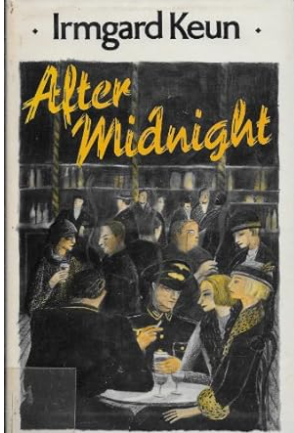
Irmgard Keun - After Midnight
Image
First published in Germany in 1937, this short novel tells the story from the point of view of nineteen year old Sanna about her family and friends as Germany is changing. It shows how the political changes impact social changes. The central theme is romance but it is really about how individuals navigate the new rules as the power of the Nazis grows. It is now published as a Penguin Modern Classic, translated by Anthea Bell.  The young women are hanging out in bars more than you might expect for the time period. I like the female references and the humour.  Some extracts: Gerti is washing her swollen eyes. We must go back to our table. My head's full of confused, random thoughts, like a ball of wool I must knit into words. I must knit a stocking of words. It takes so long, and I forget what I was going to say a minute ago, as if I'd dropped a stitch.  ..... Herr Breitwehr believed Frau Silias's story about the fake silver fox fur. So then Frau Breitwehr went off to Goden...

Cox, F., & Theodorakopoulos, E. (Eds.). (2019). Homer's Daughters: Women's Responses to Homer in the Twentieth Century and Beyond. Oxford University Press.

  Cox, F., & Theodorakopoulos, E. (Eds.). (2019). Homer's Daughters: Women's Responses to Homer in the Twentieth Century and Beyond . Oxford University Press. This collection of essays examines how women writers of the twentieth and twenty-first centuries, from various background and locales, have responded to, reimagined, and rewritten the Homeric epics. The backgrounds of these authors and the genres they employ—memoir, poetry, children’s literature, rap, novels—testify to the growing appeal of Homeric texts, and their lasting influence. The treatments addressed range from surrealism to successive waves of feminism to imaginative explorations of the future, examining Homer’s influence in a multitude of different literary and political movements, and the essays in this volume bring diverse critical approaches to the work. Authors include: H.D., Elizabeth Cook , Christa Wolf, Margaret Atwood, Alice Oswald , Adèle Geras , and Kate Tempest. It ends with Emily Wilson on her ne...

Andromache Karanika - Voices at Work: Women, Performance and Labor in Ancient Greece.

  Karanika, A. (2014). Voices at Work: Women, Performance and Labor in Ancient Greece. Johns Hopkins University Press. Andromache Karanika's Voices at Work explores the intricate connections between ancient Greek poetry, the female poetic voice, and women's labour practices. The poetic voice is intricately intertwined to domestic chores and agricultural labour, such as weaving and storytelling. Karanika identifies female poetic expression and performance in ancient Greek poetry, revealing case studies like Calypso and Circe's weaving and Odyssey 6's washing scene. By revealing the words of women who informed the oral tradition, Karanika gives a voice to silence and sheds light on the complex relationships between ancient Greek poetry and women's labour. Karanika's research expands on Lardinois and McClure's Making Silence Speak (2001), while introducing a theoretical framework to a historical and anthropological approach. She underscores the significance ...

Edith Hall - The Return of Ulysses: A Cultural History of Homer's Odyssey

  Hall, E. (2008). The Return of Ulysses: A Cultural History of Homer's Odyssey . Johns Hopkins University Press. Edith Hall’s book tracks the influence of the ideas of the Odyssey on a range of institutions and practices in the Arts. In addressing the writings of the female characters from the epic, she notes that the important ideas in the most recent writings are ‘private space, weaving and quest’ (p. 121-2). She cites the importance of Carolyn Heilbrun’s What Was Penelope Unweaving? (Heilbrun, 1990). Heilbrun’s essay proposes Penelope’s weaving and unweaving as drafting possible futures for her story.   Hall and Heilbrun encourage women to write their own stories using their own forms. Together, both writers encourage others to challenge the narratives by creating new fictions for themselves. Penelope thus becomes an emblem of this feminist project.   Hall’s observed threads of ‘private space, weaving and quest’ are worth considering in other rewritings.

Emily Wilson - The Odyssey

  Wilson, E. (2017). The Odyssey (Homer) . W. W. Norton & Company. Caroline Alexander wrote a translation of the Iliad in 2015. However, it did not receive the public attention garnered by Emily Wilson whose translation of the Odyssey was published in 2017. Wilson wrote a long introduction explaining her rationale for her approach to the translation and its importance. She was widely interviewed and travelled to promote her book.  She says in the introduction, and in her article in Homer’s Daughters (2019), that her approach to the translation is feminist. She felt a responsibility to provide a reliable version of Homer’s text to readers who have no Greek without continuing the assumptions about sex and gender embodied in male translations. She wanted to explore the fissures within the text itself, the open elements since there are points within the Odyssey where the text seems to challenge or undermine its own set of values; there are ambiguities. In her article she...

Charlotte Higgins - Greek Myths: A New Retelling.

 Charlotte Higgins. Greek Myths: A New Retelling . (United Kingdom: Penguin Random House, 2021).  Higgins is a classicist and works as cultural editor for The Guardian. Her book is a collection of reinterpreted versions of classical Greek myths. This book provides a feminist perspective on these stories and reinterprets them in a way that challenges patriarchal norms and values. The framework (used like a loom is a framework) is that the women tell these stories through their weavings. It is a collection of ekphrasis.  I had high expectations but enjoyed the attempt at the concept rather than the realisation of the project. She understands the stories, and takes permission from Ovid and also Catullus, to create such a framework, however, it was disappointingly flat. Much like the retellings in other books (children’s versions, the books of Stephen Fry) just telling the plots is only part of the point. The rest of the point is how the ancient stories were told. I’m interes...

Natalie Haynes - Pandora’s Jar: Women in the Greek Myths

 Natalie Haynes. Pandora’s Jar: Women in the Greek Myths . (United Kingdom: Picador, 2020).  In her introduction, Haynes argues that in the contemporary era, we have ‘made space in our storytelling to rediscover women who have been lost or forgotten. ‘They are not villains, victims, wives, and monsters: they are people’ (p. 3). The text itself is dedicated to revisiting the women from Greek myth beyond their symbolic, essentialised roles.  Haynes retells the story of Pandora, Jocasta, Helen, Medusa, the Amazons, Clytemnestra, Eurydice, Phaedra, Medea, and Penelope. This book tracks the stories of these female characters from ancient sources, including pictorial representations as well as ancient literature, and explores the ways their narratives have been used to perpetuate negative stereotypes of women. The book applies a critical approach to the way received understandings of the stories of these characters have shifted according to mistranslations, misinterpretations, ...